Turn-around safety principle
The ClimbThe Turn-around safety principle is the rule that a climber who cannot continue should stop and descend rather than press on. Its force in the account is stark: physical limits are not obstacles to be overcome by will alone, and recognizing them in time may be the difference between retreat and death. Yet the 1996 Everest summit attempt shows how an apparently simple safety principle can become difficult to apply when expedition plans, authority, equipment, and communication fail to provide a shared basis for turning around.
The rule in acclimatization and guiding
Before the summit attempt, clients were told that high-altitude symptoms could be hard to distinguish from the early signs of high-altitude cerebral edema or high-altitude pulmonary edema. Guides could monitor the climbers, but only each climber could report what was happening internally; frank communication was therefore essential. The instruction joined bodily self-knowledge to a conservative response: maintain reserves, take seriously the sense that one cannot continue, stop, turn around, and save one’s life.
The acclimatization plan was meant to build those reserves rather than exhaust them. On the first excursion, clients would climb to 6,100 meters, the site of Camp I, and return to Base Camp without staying overnight. They would carry only personal gear, while Sherpas carried ropes and supplies; rest periods gave the team time to recover and guides an opportunity to observe their condition. The plan’s staged ascents made safety depend not on a single last-minute act of judgment but on pacing, recovery, and monitoring throughout the climb.
Summit plans and unclear authority
The principle was harder to enforce on summit day. Mountain Madness clients were told that a third oxygen canister would be waiting at the South Summit, but the total margin was narrow: the climbers carried thirty-eight Poisk canisters, with fifteen full canisters left at Camp IV. There was not enough reserve for an overnight delay and a second summit attempt. The team had been told it was one attempt, no more.
The oxygen schedule reinforced the dependence on a timely ascent and descent. Supplier Henry Todd estimated that two canisters, used at two to two and a half liters per minute, would provide twelve hours—enough, on paper, to reach the summit and descend to the South Summit for a third canister. The midnight departure was expected to put climbers on the summit in ten to eleven hours, with only one or two hours of oxygen remaining. The plan assumed that the route and schedule would hold; it left little room for a delay.
But the clients did not share a definite summit-day turnaround time. Scott Fischer did not tell them to turn back if they had failed to reach a specified point by a specified hour. Instead, his intended system was for Lopsang Jangbu Sherpa, Anatoli Boukreev, and Neal Beidleman to lead in rotation while Fischer brought up the rear and turned back stragglers as he reached them. If difficulties arose, Fischer was expected to contact Lopsang by radio; Boukreev and Beidleman had no radios. The rule’s practical force thus depended on a moving guide-led response, without every guide having direct access to the communications channel.
This contrasted with the personal Two O’Clock Rule associated with Fischer: a climber not on the summit by two should turn around. The account distinguishes that personal guideline from an instruction imposed on his clients. Rob Hall’s clients, meanwhile, had conflicting understandings: some believed their cutoff was one o’clock, others two, and others thought the decision would be made on the mountain. A rule that might guide an individual did not become an effective team safeguard unless it was clearly communicated and shared.
Delays and the shrinking margin
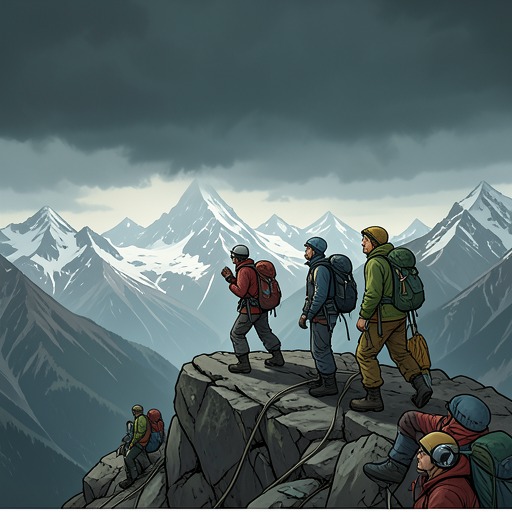
The route itself added pressure. Clients understood that Sherpas from the Fischer and Hall teams would fix the ropes before the clients left Camp IV, so that climbers would not have to wait. In practice, neither Lopsang nor Ang Dorje nor another Sherpa had left ahead to do so. The resulting delay contributed to a jam on the fixed ropes: by late morning, climbers from the two expeditions and the Taiwanese team were strung between the Balcony and the South Summit, while the Sherpas carrying the extra oxygen were also delayed along the route.
At 9:58 a.m., Beidleman reached the South Summit; Martin Adams followed about half an hour later. They waited there for roughly an hour and a half to two hours, with climbers behind them unable to pass through the bottleneck. By 10:30, Hall’s clients were spread along the route, and those using the recommended oxygen flow rate had only one to two hours left in their second canister. Their third and final canister had not yet arrived at the South Summit. Several climbers began considering whether to turn back, but the congestion and uncertainty made the decision harder: a climber’s judgment was being formed in a queue, at altitude, as the oxygen margin dwindled.
The rule was not merely a test of individual resolve. The teams had agreed to cooperate in fixing the ropes between Camp III and Camp IV, and Mountain Madness sent Boukreev in place of Sherpas who needed rest after establishing Camp III. The effort protected the team’s position among the early summit parties, but it also illustrates how expedition choices about labor, route preparation, and timing shaped the conditions under which climbers later had to decide whether to continue. When the ropes above Camp IV were not fixed as expected, the mismatch between plan and execution consumed time that the oxygen plan could not spare.
Emergency and the limits of correction
The gap between expectation and reality became critical as the day deteriorated. At about six in the evening, Boukreev prepared to go back up because the Mountain Madness clients had not returned and would soon be out of oxygen. He carried three oxygen canisters, a mask, and a regulator. Within ten to fifteen minutes of leaving his tent, clouds descended onto the South Col and a lateral snowstorm began, with winds of at least forty to fifty miles per hour. Visibility collapsed. Boukreev began using oxygen himself as he searched for the fixed ropes, at risk of losing his footing on steep ice above the Lhotse Face.
The wider emergency reflected several failures interacting rather than one isolated mistake. Radios were old and inadequate in the view of Martin Adams, who considered their limited channels a major misstep. On summit day, messages between Base Camp and climbers passed through several Sherpas, were sporadic, and were sometimes thought to be incomplete or made more reassuring in transmission. Those difficulties deprived people trying to coordinate assistance of dependable information just as weather, oxygen, route delays, and human capacity converged.
The account resists assigning the deaths to a single cause. Scott Fischer’s declining health, an apparent lack of oxygen, the hour and position at which he was stricken, poor communications, worsening weather, and the condition and abilities of potential rescuers combined in ways that cannot be reduced to one definitive explanation. That uncertainty does not weaken the principle; it clarifies its stakes. A sound rule must be supported by concrete operating conditions—clear limits, adequate reserves, a prepared route, and reliable communication—or the instruction to turn back can arrive too late, or remain too ambiguous to govern action.